Revisiting avatarspirit.net
What can we learn from a defunct twenty year old Avatar: the Last Airbender fan forum?
In the twenty-one years since Avatar: The Last Airbender's debut, the show has had remarkable cultural persistence. It is the 7th highest-rated television show on IMDB and the highest-rated animated one. Its Reddit has 2.3 million members. When it released on Netflix in 2020, it became the most-watched television show in America. Many young people who encountered it this way were born after its 2008 finale. Avatar has become a media franchise, including a sequel series, comics, books, a movie, and an ongoing $150 million budget live-action series adaptation. Long-term fans, now well into their thirties, still watch and re-watch the series today, at this point even sometimes with their own children.
Avatar's success is without precedent in American television. No animated show before or since has even remotely approached its scale and critical acclaim. Compare Avatar to its mid-2000s Nickelodean contemporaries: It is incomprehensible to imagine revisiting, with the same enthusiasm, The Adventures of Jimmy Neutron: Boy Genius or ChalkZone, the latter of which, after running for four seasons over six years, has a Reddit with 240 members. While I watched these shows as a kid (and remember almost nothing about them) I did not grow up with The Last Airbender — I first encountered it at nineteen, when I watched all three seasons, with a combined runtime of twenty-four hours, on a desktop computer over two days. The second time I watched the series was over a similarly compressed period with my ex-girlfriend during the early days of the 2020 coronavirus pandemic.
In April of this year, the animated spinoff film Avatar Aang: The Last Airbender was leaked online, four months before its planned release. After watching the first forty minutes on Twitter, it was taken down, and I had to wade through a Discord server – spammed with racial slurs and pornography – to find a download link for the complete film. Like other Avatar spinoffs, it was, well, fine. Nothing in the franchise quite captures the spirit of the original three seasons, which were truly incredible in a way that, I think, has not, and may never be repeated. Avatar Aang's main impact on me was that inspired me to watch, for the third time, the original series' 61 episodes. On this rewatch, as always, I got something new out of it.
Joshwelt on Twitter writes, "you have to rewatch the last airbender every once in a while to keep your heart pure." I was shocked that a twenty-year old show, ostensibly for children, and which has very little appeal to me in terms of nostalgia, remains exceptional. It is only "for kids" in the sense that certain topics are off limits and that the main characters are young teens, but it far transcends its form as "children's television" in a way that nothing else on Nickelodeon ever did. After some reflection, it may be my favorite television show, which might sound insane, but if you don't trust me, trust New York Times columnist Jamelle Bouie.
I may be overly-empowered to make such bold statements by my immersion, after my most recent rewatch, in the various Avatar: The Last Airbender fan communities, which have no shortage of obsesssives. One fan writes that they watch the show "Once a year. It's a tradition for me now." Another, "Roughly once a season or 4 times a year since it aired. So probably about 60 times lol." An Avatar Minecraft server administrator writes that they rewatch it "pretty much every week." Some even have the show on daily: "I normally put on 1 episode each morning before bed. It helps me get to sleep. Been doing that for ~decade."
These comments come from relatively recent threads on r/TheLastAirbender. However, fan communities for the show long precede Reddit — Avatar: the Last Airbender was released around the peak of the era of Reddit's predecessor: the standalone internet "fansite." These websites usually consisted of a blog with updates on some franchise alongside associated resources and, most importantly, a discussion board. For ATLA, this was avatarspirit.net.
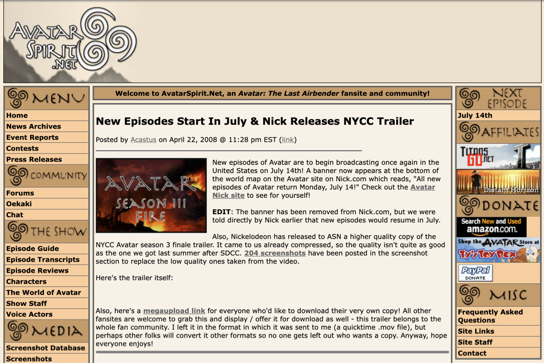
avatarspirit.net (or ASN) was founded 2005, after Avatar's first season. It was most active during show's original run, where users could provide reactions and fan theories as new episodes released. After the finale, discussion dwindled, and when 2012's sequel series The Legend of Korra came out, most of the discussion had already moved to other platforms. The forum shut down in 2020, and the site went offline entirely in 2021, today only accessible via archives. The administrators cited, among other things, a "lower level of forum activity" for their decision to close it. Avatar fan discussion over time largely moved to — in order — tumblr, Reddit, and Discord. This non-profit, stand-alone, self-hosted fan community, like nearly all of that era, died, and was replaced by small carve outs within large, centralized platforms run by private tech companies.
Jesse Lingel compares this process of platform consolidation to that of urban displacement in her book The Gentrification of the Internet:
Before social media, forming communities online meant meeting new people with a shared interest, which could be anything from Star Trek to hip hop to soccer. Early on, there were no algorithms for categorizing users, no platform-based recommendations of friends or content. People just showed up at a message board or in a chatroom and hung out with whoever was around [emphasis mine]
In other words, fan communities – organic, based on shared interests – cultivated a community that would then be mined and exploited for profit, ultimately obliterating the original character that made these spaces unique and appealing in the first pace. Lingel compares this process to that of replacing local community businesses with big-box stores like Wal-Mart – soulless, corporate entities, alienated from the particular character of "one" place, flattened into into the sameness of mass consumer culture. Online and offline, gentrification is a story of displacement, of destruction: where a community becomes fragmented, broken apart, lost.
avatarspirit.net and similar communities were created out of necessity – before big platforms, there were no alternatives for people wanting to bond online over a shared interest. This was simply what came up when people put "avatar the last airbender" into Google. The site was substantial enough that Nickelodean would send them press releases and even do interviews. Platform consolidation caused the "accessible" community to be no longer the independent one, but rather a large, centralized one.
Nothing on the modern internet resembles the structure of the 2000s bulletin board – slow-paced, tight-knit, and independent – this form, which used to be the default choice for creating an online community, is now only the choice of a relatively small number of dedicated holdouts and ideologues. Online "gentrification" saps our attention, energy and timeaway from smaller platforms, suffocating them and making them difficult to sustain. It requires more and more energy to preserve these sites against the tide of platform centralization, to the point that many, like the admins of avatarspirit.net, eventually give up.
When Avatar: the Last Airbender aired, it was, by today's media standards, somewhat inaccessible. Finding episodes was hard: many people first watched them out of order as they aired on Nickelodeon, and couldn't get the full story unless they set up a scheduled VHS recorder for live episodes, paid an inflation-adjusted $300 for all the DVD sets, bought the series on iTunes, or, most likely, pirated it online.
Online communities were similarly inaccessible to a degree, and had a relatively small population of dedicated fans, willing to make an account on a site specifically for a single TV show. Few people seek out this kind of online interaction today – fan communities now are large and accessible, they are "mass culture" on platforms ruled by algorithms, not individual personalities. The show and its fansite's inaccessibility led to kind of earnest fanaticism that mass culture largely obliterates. ASN posts lament that they were driven online by the fact that they had few "IRL" friends who shared their interest in the show. Online, they found folks from all walks of life who had this one interest in common. An administrator from the forum wrote, "I am completely surrounded by Avatar all day. We honestly talk about Avatar all the time…I MEAN ALL THE TIME." One poster wrote "I spend at least 2 hrs. a day on ASN [avatarspirit.net] and other fansites". Another wrote that they spent "4 days, 10 hours and 56 minutes" on avatarspirit.net (about three and a half hours per day on average). Another, "ive memorized all the old episodes and IM SO BORED!!!!!!! I NEED NEW ONES TO MEMORIZE…calm down". Some expressed that they dream about Avatar: "me and my best friend talk about avatar 24/7. lol. We even dream about it." Another: "I wake up crying from avatar related dreams at least one night every week […] You might think Im exaggerating, but Im not". One commenter described how her her newborn daughter, who suffered from acid reflux, spent most of her waking hours crying, until Avatar: the Last Airbender was the one thing that calmed her down, and ever since, she watches the show with her family every evening.
As you may have picked up from some of these quotes, ASN forum posters were, broadly speaking but not exclusively, teenagers – 65% self-identified as under 18. The most common age was late teens. Some rare posters mentioned being in their 20s, 30s, and 40s. Most of these posters are in their mid to late 30s today – reading posts older than they were at the time is somewhat eerie. A few of them, shockingly, are still die-hard avatar fans, but most are almost impossible to identify – having made their indelible mark, live, as teenagers, anonymously, to this forum. Nowadays, teens have few "safe" spaces online and are often and perhaps prematurely thrown directly into "adult" social media, which can be, among other things, quite vicious. Some countries are moving towards banning social media entirely below a certain age, which may be prudent, but also means, in the case of, for example, the UK's Online Safety Act, that any small forum like ASN would be swept into their ban on "user-to-user services." In the process of becoming a vehicle for platforms and mass culture, communities online that are particular, small, and insulated have become marginalized to the point of legal elimination.
The internet was a strange place to be young in the 2000s. As a kid, I spent a lot of time online on forums, but I never really knew what to make of this environment that I found myself at the forefront of – far ahead of the adults in my life. In Tao Lin's 2013 essay for The New York Times, about an a slightly earlier era, 5-10 years before my online experience, he writes:
After the Internet, my parents were privy to much less and would only rarely, and with decreasing frequency, ask about what they no longer knew. "What did you do on the Internet today?" was not a question I remember being asked. […] If they looked at me — whether I was immersed in GemStone III, on a message board, or in a chat room — I appeared to be sitting in a chair, doing almost nothing.
Before everyone was "always online," before internet culture and real world culture almost completely merged, the internet remained a strange, unfamiliar place, a frontier where people didn't really know exactly how to act. Forum culture was where people figured out what it meant to be online for the first time, and at the time, I didn't really know what it was I was doing, I just knew that I liked talking online on forums, sometimes to an unhealthy degree.
This era of Internet culture is also notable in how easy it was to archive. Most of my exploration of avatarspirit.net relies on The Internet Archive's Wayback Machine, which crawled the site thoroughly at its peak popularity. Platforms like Discord are private and ephemeral by their very nature. Modern social media also produces way, way more content, making an archive much more difficult to produce and sort through. These ASN archives, however, are, and will forever remain, incomplete. It takes active effort to "save" content online. People lose interest in things, and producing an archive, while technically pretty simple, requires specialized skills that remaining forum members may not have. The ASN archives rely entirely on The Internet Archive, a single institution housed in a building in the San Francisco's Inner Richmond district. Few, if any, other organizations or individuals would be dedicated to maintain an archive of this site in 2026.
When avatarspirit.net's forums shut down in 2020, it left these archives as the only remaining artifact from this era. ASN's forums ran SMF, a forum software developed in 2001, and they were on a version that relied on PHP 5.3, a programming language that stopped being maintained in 2015. At the time of ASN's closing, the software had unpatched security issues. Self-hosted forums require active maintenance that no one wanted to do anymore. Running the same piece of software for fourteen years is already quite impressive, but this was never intentional, it was incidental, based on inertia. As people moved on, the desire to maintain software was lost. A few small communities use newer versions of SMF to maintain their communities, but this kind of self-hosted forum software has largely been abandoned and replaced.
Some have tried to rebuild the internet of the avatarspirit.net era – Neocities (a clone of the early 00s GeoCities) may be the most famous, where people share hand-crafted HTML websites. This revivalist movement is sometimes referred to as "the small web" and is often populated by people young enough to have never actually experienced web 1.0. "Small web" users are not driven by a nostalgic attachment to a lost past, but rather a creative "repetition" that re-imagines the essence of the old web in a new light. Early GeoCities had a naive design vernacular, but Neocities users turn it into an intentional aesthetic, which often looks very little like the original.
Similarly, this is perhaps why Avatar fans enjoy rewatching The Last Airbender so much. The show is rich and layered enough that each viewing is a new experience. Its world's cosmology, loosely inspired by Buddhism, involves the Avatar being reborn endlessly, their task of balancing the elements always incomplete. The Avatar has the ability to communicate with their past lives, who continue to bring their wisdom into the present.
Some critics of Avatar: The Last Airbender's follow up The Legend of Korra deride it (and its bisexual indigenous female lead) as "woke," comparing it disfavorably to the original series. These criticisms are, broadly speaking, ridiculous, and Korra is still quite good. However, there is a sense in which Legend of Korra was embedded in a particular era – speaking to the interests of an audience of the mid-2010s. The real-world analogues, vaguer in The Last Airbender, are much more clear and pointed: Korra is a story of modernity, the first half of the 20th century. It is perhaps no coincidence that in season two, Korra becomes severed from her ability to hear from her past lives. Book three is entitled "change." While Airbender is about reverting the damage of a hundred-year war, Korra is about guiding the destabilizing forces of modernity into a new era. As such, Airbender feels more mystical, timeless, almost backwards-looking, in a world with its own independent logic. It does not really feel "about" any particular time period, nor "of" the mid-2000s, except in the sense that at the time cash flowed freely and the show's creators were given a rare opportunity to do something bold and ambitious.
Broadly, Nickelodean, along with other studios, tends towards risk aversion, which is why the lesson they take from ATLA's success is not try to make something new and equally great, but rather to endlessly spin-off and try to recreate the original series's success. ATLA's production required a creative environment and institutions that may not exist today, but it reminds us that great animated television can be made, and that the current moment is not the only one, that it is possible sometimes for the future to resemble the past.
Avatar: the Last Airbender, if the title does not make this clear, begins with loss – the main character, Aang, is the last of his people, who were otherwise entirely wiped out in a genocide, prior to the start of the series. The show often grapples with this. In season 1 episode 17, Aang finds that the Northern Air Temple, a hundred years abandoned by airbenders, has been re-populated by a steam-engine engineer and his village – refugees from a nearby flood. The young kids, unlike the airbenders who possess the power of flight, use surrounding air currents to glide around the village. The artifacts, maps, and relics of the temple have been destroyed, replaced with a complex steam power system and amenities for the villagers. Aang lashes out at them: "This is a sacred temple – you can't treat it this way!" But the villagers are shocked by his reaction: no airbenders lived there for hundreds of years, it was ultimately an abandoned husk – whatever was sacred there has long been lost with the destruction of its people. Aang softens eventually, realizing that these people, ultimately, are like his people, they were refugees, looking for a home, and, he says, they have the "spirit of an airbender." His culture is not lost, but persists in a new form.
This does not blunt the loss of his temple. But it is an acceptance of the limitations and frustrations of cultural preservation. This task is taken up later in Avatar's follow-up, The Legend of Korra, by Aang's son Tenzin. Tenzin inherited a largely dead culture from his father (Aang) and is tasked with passing it on to the next generation. But his relationship with airbending culture is unstable: he is wise and knowledgable, but at the same time stiff, hot-headed, overly-serious. Both he and Aang struggle to "go back" to a lost era. But successful preservation is not about freezing a moment in amber – no such gesture is possible. Cultures or artifacts, once destroyed, really can never come back, but that does not mean the should be abandoned, rather, a study of the past can continue to "echo" into the present, bringing its ideas to a new audience in a new era, and good archiving and preservation is a prerequisite to that possibility, which makes a study and reverence of the past so important.
The internet of avatarspirit.net likely never will exist again, but exploring the archive reminds us what the internet was, and more importantly, what the internet could be, free from the platforms that dominate it today. These archives keep 2000s forum culture alive, and much like re-watching ATLA does, allows us to escape the crushing sense that today's cultural moment is the only way to live, or that the past is entirely unrecoverable or has no bearing on the present.