Can you argue your way into believing in God?
Originally published on my Substack: Can you argue your way into believing in God?
The new generation of online Catholic apologists
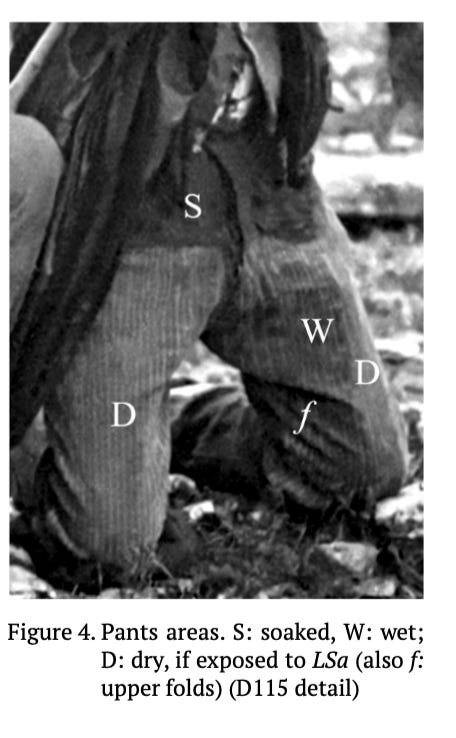
In a 2021 paper, Fr. Philippe Dalleur argues that this photograph, taken of some of the tens of thousands of witnesses in 1917 in Fátima, Portugal, shows a pattern of "infrared shadows" resulting from a warm energy-generating source that quickly dried the witnesses' clothing. These shadows corroborate visual shadows, which, through photogrammetric analysis, show the presence of a non-sun emitter of energy 12 degrees lower than the sun.
This image is cited in Ethan Muse's 8,000-word Substack post It Wasn't the Sun!, which is a response to Scott Alexander's 25,000-word Substack post, itself a refutation of Ethan Muse's original 6,000-word Substack post, Our Lady of Fatima.
According to Muse, a combination of photographic analysis and witness testimony provides incontrovertible evidence that, on October 13th, 1917, God produced several miraculous objective phenomena consistent with a prophecy that apparitions of the Virgin Mother Mary gave to three small children earlier that year in Fátima, Portugal. This demonstrates with absolute certainty what religious skeptics and other lost souls seek: that God undeniably exists, and that Catholicism specifically is the sole true religion and church. If you want photographic proof, this is it: it's all in the angle of the shadows.
Ethan Muse is a 24-year-old philosophy PhD student at Rutgers University who writes the Substack Motiva Credibilitatis. He was confirmed as Catholic in April of this year. According to Muse, Fátima is only one of the many miracles which demonstrate the absolute and undeniable truth of God's existence, his miraculous intervention into the natural order, and the specific truth of Catholicism. For Muse, the evidence is so enormous, so overwhelming, so consistent with reason, that to deny it requires that one denies in the face of God himself despite his persistent and obvious attempts to reveal himself to us. Muse has dedicated his public life over the past year to explaining the documentary evidence for these events on YouTube and Substack.
Testimony of the supernatural is, of course, common in many religious traditions, which make their own attempts to not only reconcile their beliefs with modern science, but show how their tradition can be proved through empirical study and reason. Practitioners of the Buddhist tradition, for example, may readily cite psychiatrist Ian Stevenson's Twenty Cases Suggestive of Reincarnation, wherein children demonstrate stunning, inexplicably detailed memories of past lives. Muslims, on the other hand, have the concept of i'jaz, which proves the divine origin of the Quran through its literary qualities, incomparable to any human-produced text from the same era.
Muse emphatically rejects this, or any other comparison (especially to other, similar sun miracles). For him, while non-Catholic or non-Christian testimony of the supernatural can be attributed to naturalistic causes, or, in some cases, demonic intervention, the evidence for Catholic miracles is so strong and consistent that it puts them in a completely different category: certain historical events are of obvious divine origin and vindicate the Catholic faith, necessarily drawing any thinking person towards Catholicism through their reason and study of the facts.
Muse's argument is compelling enough that it was instrumental in the Catholic conversion of Joe Schmid, a philosophy PhD candidate at Princeton and formerly atheist content creator known as "Majesty of Reason," who made a twenty-five-hour series of videos explaining the case for God and the specific case for Catholicism. It also led to the conversion of Noah McKay, also at Princeton.
Schmid tells of his conversion as a series of many changes in religious worldview: while he grew up Catholic, in high school, he studied philosophy and, encountering thinkers like Sam Harris and Richard Dawkins, became an atheist, even producing a 450-page document laying out the argument. He then slowly moved toward agnosticism, then to philosophical theism, before encountering Muse's work and concluding his religious outlook to be Catholicism. Finally, he found the philosophical system which is empirically valid, unimpeachably and completely true. He discovered this, notably, a few months ago.
Muse and Schmid have, separately, been on a media tour of the online religious space. An Ethan Muse fan channel maintains a playlist consisting of seventy-four hours of YouTube video appearances, including debates and interviews, most notably a five-hour appearance on the podcast of The Daily Wire's Matt Fradd. Joe Schmid, who largely shares and relies upon Muse's theology, has done several follow-up interviews and his twenty-five-hour video series has produced countless responses and attempted rebuttals.
Nearly all of Schmid and Muse's content is apologetic. It is not meant to explore or consider, but rather to assert a specific manner of thought as the sole correct worldview: their Catholic one. Never do Schmid, nor especially Muse, equivocate or allow space for disagreement, alternative perspectives, or the possibility of the error of their assessment (except to say that it is extraordinarily slim). They rather seek to close off inquiry, to declare, finally, the complete and total philosophical truth. They are, in this endeavor, fundamentally, dogmatic.
Social media platforms reward this kind of dogmatism, no matter the position being argued for. The internet punishes worldviews that are porous or weakly held, which may generate mild responses and less controversy. An online public figure who freely admits to their faults, their limitations, their mistakes, who speaks with humility, is at risk of undermining the authority upon which their audience is built.
This dogmatic attitude is shared not only by Muse and Schmid, but also by their philosophical opponents, whom Muse in particular is ready and eager to debate. Muse is a good debater. He is knowledgeable, articulate, polite, respectful, honest, and fair. He does not interrupt or speak over his opponent and I have no doubt that he is sincere in his beliefs. Still, Muse has not been, and cannot be convinced that any aspect of his story could be incorrect. These debates, whether Muse vs Atheist, Muse vs Protestant, Muse vs PhD Philosopher or any of the associated commentary on the commentary, no matter how well-run and respectful they may be, are structurally not productive explorations of thought. They are, by their very nature, a performance for an audience, whereby participants leverage their rhetorical skill to defeat their opponents.
It is clear that Muse, in every debate, always wins. He is always more prepared than his opponent and has a ready answer for any objections they may have. It is clear that Muse has simply thought so much more deeply about this subject that it is nearly impossible to defeat him on his terms, i.e. to prove through debate why one should be skeptical of his miraculous claims.
There is another way in which Muse always wins. Muse's argument, with its thoroughness, depth, and claim of objective truth, finds its way into the brains of people susceptible to the temptations of debate, drawing in discourse towards himself and his project. Muse argues for something so bold and so preposterous with such rigor and rhetorical skill that many find themselves compelled to demonstrate in great detail how he could be wrong. Anti-Muse debaters, in both text and video, confident in the importance of debunking his claims and their specific capacity to do so, find themselves sucked into the vortex of 20th century miracle documentation, zooming in on 100-year-old photographs, trying to find flaws in Muse's shadow analysis.
While Muse has succeeded in drawing some people to Catholicism, he has succeeded to a much greater degree in drawing them into debating online about the vindicatory nature of specific miracle claims. He has succeeded, for example, in consuming an enormous amount of my time, not in witness of Christ, but toward the idol that all of this activity is primarily in service of: producing discourse on internet platforms.
In terms of the actual matter at hand, whether these miracles prove that Catholicism is for real, the only winning move is not to play. As an endeavor, it seems far-removed from what Christianity is about. Where, in any of this discourse, is the humility, the compassion, the grace?
Schmid's 26-page conversion research document is exemplary of the intellectual foundations that both he and Muse share: books on analytic philosophy and, more commonly, Substack bloggers and YouTube videos with titles like "The Largest Miracle Of The 20th Century: Scientifically Proven" and "Redeemed Zoomer DESTROYED on the Council of Constance." I watched many of them.
Ostensibly, Muse and Schmid are arguing for Catholicism. You'll notice, however, that neither in Muse's writing, nor in Schmid's document, is there a single reference to an official declaration of the Catholic church itself, nor to any statement of any pope or even cardinal. This is because the Catholic church does not make the same claims Muse and Schmid do about miracle testimony.
The most recent guidelines on the church's attitude towards post-biblical miracles (i.e. "private revelation") were adopted in 2024. The highest designation that an event can be officially recognized as is "Nihil obstat," or "not forbidden," which states (emphasis mine):
Without expressing any certainty about the supernatural authenticity of the phenomenon itself, many signs of the action of the Holy Spirit are acknowledged "in the midst" of a given spiritual experience
Later, it is said, in summation:
it is not foreseen in these Norms that ecclesiastical authority would give a positive recognition of the divine origin of alleged supernatural phenomena.
In other words, the Church does not claim that the events at Fátima, nor any other supernatural event after the death of the last apostle, are of divine origin. They may tolerate or even encourage belief in the miraculous nature of certain events, but belief in these miracles is not required of Catholic faithful, nor officially claimed with certainty.
While debates with Muse may appear to be about Catholicism, they are more accurately debates about his idiosyncratic theology that claims empirical study of miracles like Fátima vindicate the Catholic faith. There is nothing he says that, to my limited secular estimation, is strictly in conflict with Catholic doctrine, but the story that he lays out makes far stronger claims than the official Catholic interpretation of these events. For the church, the strongest evidence for its teachings comes from public revelation, i.e. the truth revealed by God in scripture and the tradition of his church.
Miracles of the kind Muse discusses, and apologetics generally, are also not how the church prioritizes its evangelical efforts. In Pope Paul VI's 1975 exhortation, he emphasizes the strength of evangelizing through being a witness to Christ, in other words, living a holy life consistent with belief in the Gospel.
Through this wordless witness these Christians stir up irresistible questions in the hearts of those who see how they live: Why are they like this? Why do they live in this way? What or who is it that inspires them? Why are they in our midst? Such a witness is already a silent proclamation of the Good News and a very powerful and effective one.
Later,
It is therefore primarily by her conduct and by her life that the Church will evangelize the world, in other words, by her living witness of fidelity to the Lord Jesus- the witness of poverty and detachment, of freedom in the face of the powers of this world, in short, the witness of sanctity.
I cannot speak of Muse, Schmid, or any other online newly converted Catholic apologist's personal witness to Christ, nor their everyday conduct. Perhaps Catholicism has transformed them into radically different, more Christ-like, people. However, I can tell you one sense in which it has not: in the dedication of their energies toward defending their personal dogma in online debates, declaring themselves the absolute and final authority on philosophical matters. From an outsider's perspective, watching these debates, I see almost no difference between each "side." Every participant is caught up in the same endeavor, the same war-like manner of doing discourse, the same lack of flexibility and porousness in their worldview. Catholicism could readily be swapped out for any other religious doctrine or political ideology and the form of these discussions would be unchanged.
This is a major difference from, say, other practitioners of Christ. For anyone who has lived a thoroughly Catholic life, such as formal representatives of the Church, their conduct is thoroughly and particularly Catholic. Their faith is not an intellectual project, but a fundamental and unimpeachable part of who they are. If they came to believe different things, they would necessarily be different people. A serious Buddhist or Muslim practitioner differs from a Christian one primarily not in their different philosophical worldview, but in how those worldviews and their associated institutions produce different lives, as representatives of their tradition. That level of religious commitment does not require argument, it requires practice and study.
As a secular person, it matters not to me whether someone is formally a member of this or that religious tradition. I care far more about how that tradition transforms them. It is far less interesting to me which religion is "true" (such a question is, as Immanuel Kant would say, beyond the boundaries of reason, inaccessible by its very nature), but rather what religions are, what does it mean to live a Catholic life, and how does it differ from a Muslim, or Buddhist life? This is not to collapse all traditions into a kind of secularism, but to understand, preserve, and honor what is particular to each tradition as valuable in itself, valuable without having to insist that the plurality of faiths resolves to a single, dogmatic way of being. I value interfaith dialogue, I am interested in how religious traditions can learn from each other, and especially what secular people can draw that is valuable and good from an encounter with religious witnesses.
As opposed to apologetics, spiritual practice is much harder to demonstrate on social media platforms. At its best, religious faith cuts against a dominant cultural environment, it draws one towards values that are eternal and rooted in tradition. It calls one to practice love, kindness, and grace in environments where these values are not materially rewarded. In the world of online content creation, it means understanding the base and corrupting nature of these platforms and their culture and despite that maintaining, to the best of one's ability, one's piety.
This is radically opposed to the online apologetics' emphasis on debate, the compulsion to "prove" the complete correctness of their tradition. Dogmatic apologetics do not, in any respect, cut against the culture of, say, Substack, where Catholics like Muse debate with precisely the same self-assuredness as secular people, encouraged by the controversy that their dogmatism produces.
However, not all may be lost. In a follow-up video on his conversion, Schmid discusses in more detail what a Catholic spiritual life looks like. He still demonstrates his obsessive analytic towards the rules of Catholicism and how its objective correctness makes obeying them very serious. Beyond that, however, there are moments wherein he seems to touch something deeper, a genuinely spiritual life centered on the exhortation to love thy neighbor, wherein religious practice moves his life toward that truth.
In the Buddhist tradition, the Dharma (teachings of the Buddha) is compared to a raft, which one uses to cross the river towards enlightenment, but once across, a raft that one leaves behind. Perhaps, for Schmid or Muse, arguments from analytic philosophy and documentary miracle claims were the raft required to bring them to a more sanctified life. It is certainly a strange, and, at least to me, wholly unconvincing raft, but if it is capable of bringing people towards a more joyous and compassionate way of being, and left behind once one is there, perhaps there could be value to it. However, to this point, humility, tolerance of difference, and a new way of life do not appear to be the emphasis of this conversation, and apologetic debates have largely become an end to themselves, a means of sating one's desire for intellectual dominance, more grist for the content mill.